Showing posts with label Earnings. Show all posts

Monday, July 16, 2007

Some Thoughts On Earnings Season

This week marks the first round of earnings reports. Companies expecting to report include Eaton (ETN), Merrill Lynch (MER), Coca-Cola (KO), Johnson & Johnson (JNJ), Intel (INTC), Yahoo (YHOO), Altria (MO), JP Morgan (JPM), eBay (EBAY), Google (GOOG), and Caterpillar (CAT). These reports will try to justify the great month that all of the major indices are having.

The only real earnings precursor came last week with reports from Alcoa (AA) and General Electric (GE). Both stocks boosted strong earnings results and investors responded nicely, but I am not entirely confident that the post-earnings rallies were due to the financial status of the firms. AA was down pre-market, but when an analyst suggested the buyout attractiveness of Alcoa, the ticker arrows quickly shifted direction.
GE had a really great report as well, but the total market was in the mist of a strong rally and GE may have simply rode the market wave last Friday.

Some final thoughts and a Bearish Warning:
Last season I suggested that investors would continue reacting well to earnings beats, even with the lowered yearly expectations. I am confident that if the beats continue, investors will once again ignore the lowered expectations and reward successful firms. I also predict that in-line reports will not be good enough to sustain the summer rally. A large part of this bullish run is unwarranted and not justified by earnings reports, leaving much of this month's run-ups susceptible for a pullback. I would encourage investors to wait a day or two and investigate the initial reports to better gauge the potential success for the rest of the earnings season.

Good luck all!

Thursday, May 10, 2007

A Recap of Prior Plays

I felt obligated to share the performance of the trades I proposed on this blog. I went all the way back to my November posts (which apparently I was doing my best work) and found how each pick turned out.
The table below shows the performance of my November 10th picks. I simply assumed the investor would have bought shares at the closing price on November 10th and sold the stock after the week was over, sometime around November 15th.

The table below shows the success of my IPO evaluation on November 15th. For these stocks, I assumed the investor initiated a market order when these stocks started trading and sold the stocks at the end of the day.

The table below highlights my most recent round of earnings plays. Like all earnings plays, I assumed the investor bought the stock sometime after the post or around the close before the earnings report and sold the stock the next day sometime around the close.

The last table is my recently recommended "technical analysis" stock. I will try to add more of these as I learn more about TA.

You can interpret these tables however you like, just thought I would throw them out there.

Monday, May 07, 2007

I Like Marvel Going into Earnings

There is nothing wrong with chasing momemtom, so I am chasing Marvel (MVL) going into the company's earnings report on Tuesday. The stock is slightly off its 52 week high and has a slightly higher P/E ratio compared to its competitors, but the potential earnings this new Spiderman movie could bring in is amazing. This weekend Spiderman became the highest grossing opening-weekend movie ever. Marvel not only makes money from the movie, but also from the action figures, clothing and trading cards. All of these outlets translate into Marvel royalities. Earnings Whispers expects a four cent beat, but I can only suspect that Marvel will raise its guidance with the recent success of Spidey.

I am looking beyond the fundamentals and trading on a good feeling. Hope this works out.

Thursday, May 03, 2007

Buying Companies You Like

I watched an interesting program Monday night on CNBC detailing how four successful entrepreneurs made their money. Phil Town was one of those entrepreneurs and he made his money in stocks. Phil suggests that individuals invest in companies that make products that they like. He reinforced this point by stating that if a particular audience member bought shares in the company that made her purse (Coach) several years go, she would have more than tripled her initial investment.

I thought I would try this strategy myself and bring some of my earnings passion into the mix. The day after the program I bought some shares of Buffalo Wild Wings (BWLD). The Bloomberg printout looked pretty attractive; returning an average gain after the earnings release of 8.63%. While BWLD showed a great Bloomberg report, there were still several stocks that showed a greater string of successes. These stocks, however, were not companies that made products I liked, or even heard of for that matter. So I went with Town’s advice and played the stock that makes tasty-wings.

The company beat the street and raised guidance and I was happy to make more than 14% on my initial investment. I will try to incorporate this strategy a few more times and keep everyone updated on how these plays shake out.

Happy Trading…

Tuesday, May 01, 2007

Straddle Time!

I mentioned before in my series on options trading how to make money if you are unsure which way the stock may go in the future. I also pointed out that options are a zero sum game, making them inherently riskier than stocks. With that being said, I feel that investors have a significant chance of making money by using a straddle on Affiliated Computer Services (ACS) going into earnings.

Let's review the key elements of an attractive straddle. One of the most important aspects of a good straddle is the current price of the stock. The closer the price is to strike price of the call and put you are going to purchase, the better the straddle play is. The second most important part of the straddle is the costs to straddle. The cost is cheap if the break-even future prices are significantly less than your predicted future movement. The third most important part of a straddle is the time value of your option position; the longer you have to sell your call and put the less risk you are taking on.

Given these elements here's how ACS stacks up:
- The current price of the stock is only 9 cents away from the $60 strike price.
- I managed to pay $1 for both the call and put, meaning the stock would only need a 3.69% increase or a 3.46% decrease to be in the money given my broker’s options trading fees. As you can see from the Bloomberg image below, this straddle would have been in-the-money five out of the last six sessions after the earnings report.
- If you do take this position, you have the luxury of waiting until the 19th of May to liquidate your positions; a long time given this volatile market.

So why is this so cheap? There have been significant buyout talks driving the price of these options. I feel that this is insignificant because these talks have lasted for several months and it appears that shareholders are ultimately unsatisfied with these offers. In fact, I feel that this release will have a great impact on the bid price of this buyout firm, ultimately allowing for significant share price volatility.

Monday, April 30, 2007

EMR and NMX for Monday

I like Emerson Electric (EMR) going into Tuesday morning's report. Like last Friday, I wanted to find a company with a history of earnings success, and Emerson fit this mold. The company has beaten the estimates each of the last six quarters and averaged a next day gain of almost three percent. The company's P/E of 20.46 is only slightly above the industry's standard, giving the stock some downside support should the company miss estimates. Also, Earnings Whispers projects that the company will beat the street by three cents.

It's important to note two dangers of the stock. The first is that the stock is trading a little bit below its 52 week high. I argue that many stocks have hovered around their 52 week highs going into earnings, and these stocks were able to explode past these technical barriers. My second concern is the sell-off going into earnings. Many stocks do sell-off going into earnings and I feel that investors are simply being risk-adverse and are not willing to take on the risk that comes with an earnings announcement.

As I mentioned in an earlier post, I also like NMX today.

Good luck!

Friday, April 27, 2007

BEAV For Friday

I like BE Aerospace (BEAV) going into earnings today. BEAV provides interior services to an array of different types of airplanes. The stock is marginally up after a series of airline stock downgrades, leading me to believe that many are confident this airline services provider will beat the street. I am confident in BEAV because of the run-up in airline producers and the high demand from these companies. Stocks like Boeing (BA) have shown significant capital gains and high dividend payments throughout the last year.

Another attractive aspect of the stock is the recent success in earnings. The company has beat the analyst expectations five out of the last six quarters and shares have advanced the next day after each of those reports. I am a strong believer in prior success translating into excellent future results. The only risk in playing this stock is a relatively high P/E and six month run-up, leaving the stock susceptible to a sharp downturn.

Personally, I am willing to take on the risk given the history of success. Good luck.

Thursday, April 26, 2007

The NYMEX

I like the Nymex (NMX) going into the company's first quarter results. Over the last couple of weeks I noticed that significant buying pre-release is usually a great indicator of a potential estimate beat. The intuition beyond this strategy is that risk-adverse investors usually sell the stock before the earnings in case the stock does miss. If there is strong drive up in the price of the stock, supported by high volume, there may be a large number of investor groups that are speculating that the stock is going to report good numbers. Given that many investors are risk-adverse, NMX chart suggests that these investors feel the stock is a sure winner.


Along with a strong chart, NMX should be posed to show great numbers because of the fluctuation and bullish drive in commodity prices. The volume on the exchange was significant last quarter, and with this increased fluctuation it would be safe to say that these volume numbers should have continued this quarter.

I bought in this yesterday, but I still recommend the stock today. Good luck!

Friday, April 20, 2007

How I Made 16% On A Stock That Went Down 9% Without A Margin Account: Part 3 of 3

Now that everyone comprehends the basics of options, what some simple strategies are, and how they leverage gains and losses, I can start explaining some more complicated strategies.

Butterfly Spread
If the investor is confident that a particular stock is going to be the same price today, sometime in the future, the investor could: long the stock and make no money, short the stock and have the ability to make money elsewhere, or use options to make money on the non-movement itself. To do this an investor would take long position at strike prices where the investor feels the stock will not pass given the time interval (if you think the stock will not go past $27 and $29, you would buy calls at strike prices of $26 and $30). The investor would also take a "double" short position at the strike price the investor feels the stock will hover around (if you think to stock will hover around $28 you would sell two calls at a strike price of $28). The investor would make the most money if the future stock price stays at the strike price of the shorted call position. The investor will lose money is if the future price breaches the outer long call strike positions. These losses are caped, however, because each move up in the stock price means the long positions' value will go up, but the short position will go down and vise-versa on the lower extremity. The payoffs look like this:

Straddle
If an investor wants to take the opposite strategy, they would likely create a straddle. A straddle involves longing (purchasing) a call and a put at the strike price you feel the future stock price will be farthest from (usually the strike price closest to the current stock price). In order for the investor to make money on this strategy, he/she needs the future price to be greater than or less the strike price in excess of the sum of the call premium and put premium. Let's say the call and put each cost $3 at a strike price of $65. The investor would need the future stock price to go up to $71 (65+3+3) or down to $59 (65-3-3) to be in the money. The strategy is shown below.
I replicated the straddle strategy last week when I started this trilogy of blog posts. I managed to make more than 9% fluctuation in the stock because of the leverage that options create. Since then, I managed to make money on only one of my next three plays. Luckily, I am only down $30 on options. In short, I recommend that you only do options if you are truly willing to accept the risks you take on to achieve such high returns.

Thursday, April 19, 2007

How I Made 16% On A Stock That Went Down 9% Without A Margin Account: Part 2 of 3

Now that I established what options are, I will start to lay out a couple strategies using options and how you can achieve higher returns.

Bull Spread:
If an investor feels that the stock will go up, hence the name bull-spread, he/she can create a strategy to achieve gains, while capping losses using options. To do this the investor would sell a call (or put, works with both) at a lower premium and buy a call (or put, works with both) at a higher premium. The investor will be losing money at first, but the purchased call will not need much movement to be in the money. In the example below, the investor buys a call at a strike price of $40 for $3 and writes a call at a strike price of $45 for $1. If the future stock price is $40, the investor would lose $3 on his/her long position, and gain $1 on his short position. If the stock price were to advance to $42, the investor would only be down $1 (42-43) on his/her long position, but still up $1 on his/her short position (so even overall). If the stock price were to advance to the written call's strike price, the investor would be up $2 (45-43) on his/her long position and would be flat on his/her short position. Anything in excess of this price would still result in $2 of profits because each up-tick in the stock price would yield a $1 gain on your purchased call, but a $1 loss on your written call (the investor would exercise this call).

Bear Spread
The investor could take the opposite strategy by simply reversing the written and purchasing positions. This investor would sell the option at a premium and buy the option for cheap. The strategy would draw out to be something like this:
These are two of the most common option strategies. An investor may ask, if I was bullish on a stock and wanted to cap my losses and gains, why wouldn't I just set stop and limits? The answer is that this strategy is inherently cheaper than buying the stock and setting limits. Let's say the same investor that took the bull spread strategy decided to purchase the stock instead at $42. If the stock were to go up two dollars the investor would be up 4.76% ($2 gain/$42 paid). Now lets say the investor took the bull spread position. That investor would be up two dollars on a two dollar investment, which is 100% ($2 gain/$2 paid)....

Again this is part two of three in this trilogy. Part three coming later on today.

Wednesday, April 18, 2007

I like Allstate for Today

I did not post yesterday because I was not really convinced the market could keep on rolling. I missed out on Intel, but Yahoo and others got killed. Today I am going back to my sweet spot of last week, insurance companies.

One of Progressive's (PGR) biggest competitors is Allstate (ALL), who reports today after the close. Progressive's report was great last week, citing that claims were at reasonably low level. That leads me to believe Allstate will be blessed with the same success. Allstate's P/E is 7.86, a little less than five points lower that PGR's. This means that this stock is inherently cheap and a good report could drive the stock back to a more appropriate price.

Earnings Whispers projects earnings of $1.93, six cents above analysts expectations. The stock is still five points off of its 52 week high, so it faces little resistance to a big up-swing when a good report happens. It appears that many are buying this bad boy today going into earnings, so act quickly!

Good Luck!

Monday, April 16, 2007

Two Strategies for Today's Earnings

I have two potential earnings strategies for today. If you are a risk-adverse investor, consider diversifying your risk across an array of earnings plays. If you can take on a little risk, consider going long in United Community Banks (UCBI).

If you like to play historical trends when choosing stocks, then you would be a fool to pass on UCBI. From the chart below you can see that the company has beat estimates five out of the last six quarters and has advanced after the report for each of these quarters. I have to rush a bit to get this out before 4pm, but the chart shows that the company is legitimately off its highs and needs a catalyst to get back to these levels.

Since there are so many other great earnings plays available, I suggest buying the stocks listed in the table below. This table simply shows stocks that Earnings Whispers believes will beat the estimates. Many of these stocks will advance, some will decline, but in total, these stocks should advance.


Sorry for the short post, good luck!

Wednesday, April 11, 2007

DNA is Ready to Climb, RIMM Dangerous

Good news came this morning when investors reacted well to Alcoa's and Progressive's earnings beats. Yesterday, I suggested investors stay away form Alcoa and buy into Progressive. While I wrong about Alcoa, the stock only went up about 1.5%. Progressive, on the other hand, is up 5.2% on its modest beat. Good job to longs on both of these trades.

I like Genentech (DNA) going into earnings today. I have a little bias in this decision because I made a pretty nice profit buying this stock last quarter. What's unique about this play is the fact that the stock is trading near its pre-earnings price of last quarter. What does this mean? The stock has significant room to move back up to the $88.00/share it was trading at after last quarter's release. DNA's P/E is slighty above its peers, but not enough to warrant any significant downside potential if the numbers were to miss. DNA has also beat estimates each of the last four quarters. A history of success at a low price makes DNA my play of the day.


Finally, I want to caution RIMM investors. RIMM has a great history of beating the street, but the price changes the next day to not accurately correlate with the earnings beat. That being said, it appears pointless to speculate on this stock going into earnings, because any accuracy in your earnings derivation will not necessary result profits the next day.

Good Luck All!

Tuesday, April 10, 2007

No Plays For Today

I wrote earlier in the week suggesting that investors should wait to see how the market will react to single-digit earnings growth before exploring any earnings plays. I stand firm on this recommendation with the companies reporting earnings today.

The two big releases are Progressive (PGR) and Alcoa (AA). Earnings Whispers predicts that AA will meet analyst expectations of $.77 a share, but my Bloomberg research, with a larger collection of analyst predictions, sites a mean expectation of $.78 a share. If the fundamentals Earnings Whispers uses to derive their estimate are correct, and the release is inline according the Earnings Whispers, the number will still miss according to a larger sample of investors. Alcoa has also dropped three out of the last five quarters after their earnings release signifying that the stock is not exactly an earnings champ. Alcoa is also trading near a 52 week high creating a resistance barrier that would require an adequate beat to break (or at least a beat that would quantify Aloca's above-industry-standard P/E ratio). Too much has to go right here for the longs to win on this one.


Progressive is a bit more attractive because of the stock's recent success during earnings season. The stock has beat the street the last four quarters due to a relatively low amount of natural disasters (hurricanes, etc.). These disasters have remained relatively low the last couple months, so it may be safe to assume the PGR will make it five straight. PGR is also trading near its 52 week low allowing investors to drive the stock up to a more appropriate price level if the numbers are good. All of this, coupled with an appropriate P/E, gives PGR a better chance to move positively tomorrow that AA.


With all of this said, I am still sitting on the sidelines today. Good luck all.

Monday, April 09, 2007

How I Made 16% On A Stock That Went Down 9% Without A Margin Account: Part 1 of 3

Most of the time I usually blog about long plays; stocks which meet my pre-set criteria and I believe will go up the next day. An investor could also take the opposite position and make money by shorting stocks that he/she believes will go down. Many novice investors may only comprehend these two ways of making money on stocks. My next series of posts will eventually establish several ways to make money without knowing the direction of the stock.

An option is a financial instrument that allows the investor the right to buy or sell the matching stock in the future at a given price. As a bullish option purchaser (I feel the stock is going to go up in the coming weeks), I have the right to buy a stock in several weeks at the price specified by the option today. It is important to establish several terms:

Strike Price (K): The transaction price available to the option purchaser in the future
Call Option (C): The right to buy the security at the strike price today, sometime in the future
Put Option (P): The right to sell the security at the strike price today, sometime in the future

So let's do a quick example using this terminology...
Let's say K = $50, C= $2, P = $1.
- A bullish investor has the right to buy the stock in the future at $50 for a premium of $2. If the stock in the future is $53, the investor would exercise his/her right to buy the stock for the strike price of $50 for the call option premium of $2, making a profit of $1. If the stock in the future is $47, the investor would not exercise his/her right to buy the stock because his strike price was $50; this investor would simply lose his/her $2.
- A bearish investor has the right to sell the stock in the future at $50 for a premium of $1. If the stock in the future is $53, the investor would not exercise his/her right to sell the stock because his/her strike was $50; this investor would simply lose his $1. If the stock in the future is $47, the investor would exercise his/her right to sell the stock for $50 at a $1 premium, making a profit of $2.

Some final notes about purchasing options:
Options are a zero sum game. There is always a winner and loser when trading options (unlike stocks were everyone can be a winner). When purchasing an option, you are betting the option writer that the stock will go higher (or lower) in excess of the price of the option premium. Sometimes you are right and sometimes you are wrong.

Sunday, April 08, 2007

Big Week For Earnings

This week is the first week that companies start reporting first quarter earnings. This week is likely to be a great gauge of how effective earnings plays may be in the coming weeks. I am confident that many stocks have the ability to beat the analysts' expectations, but I am unsure that these beats will translate into upward gains.

This quarter is unique because it is the first time the investment gurus are expecting less than double-digit gains from the first quarter results in 2006. There is significant concern that even if the numbers beat the estimates, stocks would sell off because investors would be discouraged with single-digit percentage gains in their EPS reports. That being said, I would encourage investors to invest this week with caution and check this blog regularly for an array of earnings plays.

Tuesday, April 03, 2007

Earnings Plays for Tuesday

I like two stocks using two different investing strategies (I will be positing the options strategy tomorrow). Robbins & Myers (RBN) has a strong correlation between earnings surprises and next day price change. This means the stock's performance after the release is highly dependent on the release and only the release. RBN also appears to have limited downside after their releases. The stock has missed the estimates 3 out of the last 5 quarters, but the lowest the stock has dropped after these releases was -1.5%. On the other hand, the two beats amounted to next day gains of 6.9% and 19.6%. The stock does have a higher P/E than its main competitors, but not enough to warrant significant downside pressure on the price. Another bonus is that the stock will pay a dividend to shareholders with ownership on or before April 9th (next Monday).

Thursday, March 29, 2007

Playing Global Payments (GPN) Before The Earnings

When evaluating GPN I found several positives given the recent decline in the stock. GPN has a lot of analyst support with mean year-end price target of 50.00. GPN is currently trading at 38.90 and has hovered around that level since their last earnings miss.
This is a good opportunity for investors to cash in on a potential upside catalyst. The recent sell-off has pushed the stock's P/E below the industry's average, reducing a lot of downside pressure on the stock if tomorrow's earnings go bad. Another nice thing about this play is the high correlation between the earning surprises and changes in the stock's price (around .964, with 1 being the highest). With this correlation investors do not have to worry about having a negative stock reaction after a positive release.
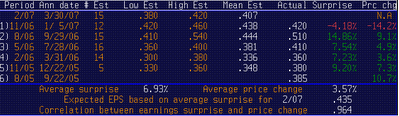
The one potential problem with the stock is the third quarter's substantial miss. Buying into a negative stock is always risky and should be noted. While the last report was not encouraging, the prior four quarters beat estimates handily.

I am buying this stock with a limit of 38.98. Due to the recent plunge of the stock, I feel that any beat could yield up to an 8% run-up tomorrow. A miss should result in less than a 4% plunge due to the low P/E ratio.

Lessons Learned

I learned some lessons yesterday so I am refining/adding to my earnings evaluating process.

Change #1: Respect High Multiples
- KMX was riding on a really high multiple (P/E ratio) which basically states that investors have priced in a significant amount of expected earnings growth into the stock price. This high multiple ultimately left a significant amount of downside pressure on the stock. The company missed the estimate and investors questioned the accuracy of the P/E ratio and sold the stock.

Change #2: Evaluation of Downside Surprises
- I was too blinded by the history of CarMax's recent successes to property forecast the consequences of an earnings miss. For future earnings plays I will attempt to retrieve a better understanding of what the stock may do if the numbers aren't so great.

Change #3: Stay Away From Cramer
- After I purchased KMX my friend mentioned that Cramer told his fellowship to buy the stock before the earnings. The stock price was highly inflated when I got in the game because of the pull Jim Cramer has on investors. Cramer has a recent history of terrible stock picks (CWTR, STZ, the list goes on) and picking a stock that he likes is a true mistake.

I will be posting potential plays later on today...

Wednesday, March 28, 2007

Three Earnings Plays

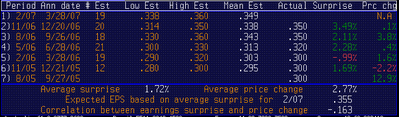
Basically there are three potential earnings plays that I like today, but I am only going to act on one. Well start with Paychecks (PAYX). PAYX, quoted at 39.50, is slightly off its 52 week high of 42.50. Earnings Whispers says the company will beat the estimated earnings number of $.35 by a penny. Paychecks has beat the estimate four out of the last five quarters and the one time it missed the stock actually moved up. This appears to be a good play for a safe investor. I do not think the stock will move much more than 2% either way on the news, unless the actual earnings are significantly different.

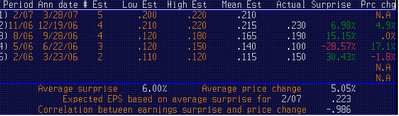
A more riskier earnings play is Smart Modular Technologies (SMOD). SMOD is well off its 52 week high and has recently had significant trend downward. The stock has beaten estimates three out of the last four quarters, but moved up significantly after the one miss. Earnings Whispers feels that SMOD will beat the estimates by a penny, but if SMOD keeps up is historical trend of beating estimates, one could expect another penny higher. Investors should be cautious of this stock because of the volatility around earnings. SMOD has averaged a 5.05% price fluctuation after the release. Personally, I am going to stay away from this one.

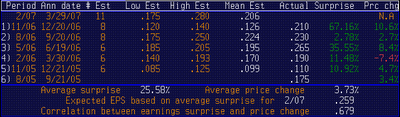
I am going to play CarMax (KMX). This stock is slightly off its 52 week high and needs the proper catalyst to break through that technical barrier. I think an earnings beat could be the answer. CarMax has smoked estimates five quarters in a row, beating the consensus expectations by an average of 25.58%. The stock moves around 4% each earnings release, which I can afford to lose. The Earnings Whisper number is $.47 compared to $.21 cents a share, signifying a potentially mammoth beat.

I set my limit for $27.35; see you at $30 tomorrow!